
Smart Buildings
Our IoT wireless, battery-powered sensors can be deployed quickly across your entire building or campus—no wiring, no disruption.
Get real-time insights from day one and scale effortlessly as your needs grow. Cloud-Based software
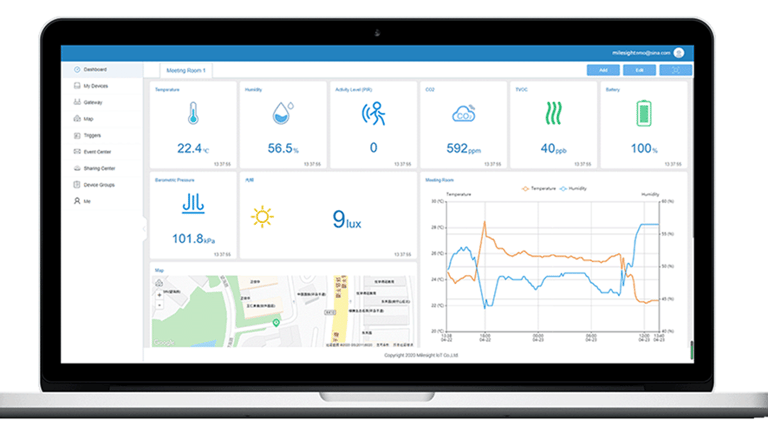
Wireless IoT Sensors
Wireless IoT sensors are smart, electronic devices that detect and measure physical conditions (like temp, motion, humidity) in their environment, convert that data into digital signals, and transmit it wirelessly over networks (Wi-Fi, Bluetooth, LoRa) to a central system for analysis, enabling remote monitoring, automation, and data-driven decisions without complex wiring. They form the "nerves" of the Internet of Things (IoT), allowing machines and objects to "talk" and provide real-time insights, often with long battery life for easy deployment.
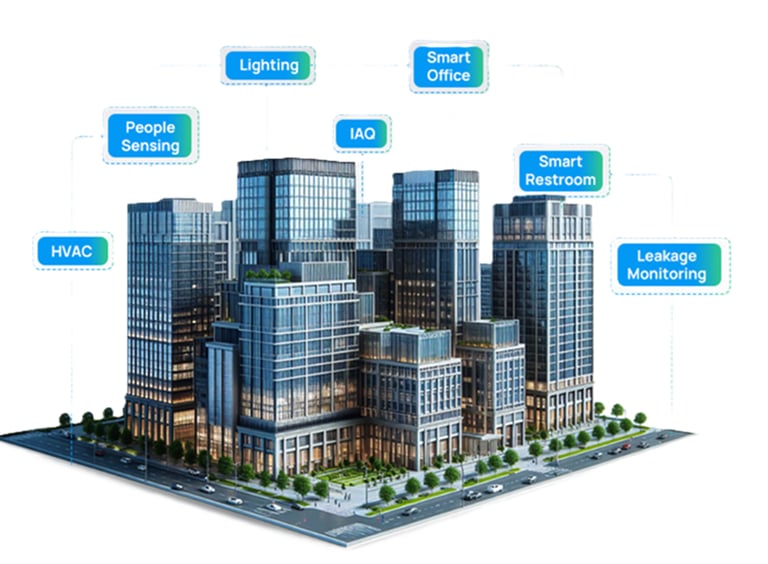
Temperature and Humidity Sensors
Temperature and humidity sensors are essential for optimal indoor climate in smart buildings, providing real-time data that enables heating, ventilation, and air conditioning systems to adjust automatically for maximum comfort.
For example, in large office buildings, temperature sensors can detect fluctuations in different areas and adjust the heating or cooling system accordingly. In data centers, where maintaining a specific humidity level is crucial, these sensors prevent excess moisture that could damage sensitive electronic equipment. For some specific building applications, like museums and galleries, temperature and humidity sensors are used to preserve artwork and artifacts by maintaining stable indoor conditions.
In each of these environments, these sensors ensure energy efficiency by allowing systems to operate only when needed, reducing both operational costs and the building's overall energy consumption. By optimizing environmental control, temperature and humidity sensors contribute to a sustainable, cost-effective, and comfortable building environment for occupants and equipment alike.
Occupancy Sensors
Occupancy sensors are indispensable for energy efficiency and automation in smart buildings, as they detect the presence of people in a room or space and adjust building systems accordingly.
In office buildings, occupancy sensors ensure that lights and HVAC systems are only active when rooms are in use. When a room becomes vacant, lights are automatically turned off, and temperature controls are adjusted to conserve energy. In terms of security, occupancy sensors are used to detect unauthorized movements in sensitive areas or after hours, providing an additional layer of protection.
By automating energy consumption and enhancing security, occupancy sensors offer significant operational cost savings, and improved safety, and contribute to more sustainable building operations by ensuring resources are utilized only when necessary.
Air Quality Sensors
Air quality sensors are essential for maintaining a healthy and comfortable indoor environment in smart buildings. These sensors continuously measure various pollutants, including CO₂ levels, particulate matter (PM2.5), and volatile organic compounds (VOCs), providing real-time data to building management systems.
In office buildings, air quality sensors monitor CO₂ levels, ensuring fresh air circulation by integrating with the HVAC system, working when occupancy increases, and improving employee comfort and productivity.
For schools and classroom environments, by measuring CO₂ and particulate matter, air quality sensors help optimize ventilation to create a healthier learning environment. In smart commercial spaces, such as shopping malls or conference centers, these sensors help maintain optimal air quality, enhancing visitor comfort and experience by preventing the buildup of harmful pollutants.
Leakage Sensors
Leakage sensors are crucial in smart buildings' water management for detecting and preventing water damage by monitoring for leaks in various systems, including plumbing, HVAC, and roofing. These sensors are designed to detect the presence of water or moisture in areas where it should not be, providing early warnings to prevent significant damage and costly repairs. For facility management, such early detection is especially valuable, as it helps reduce unplanned downtime, avoid emergency maintenance, and maintain the overall reliability of building assets.
In commercial buildings, leakage sensors can be placed around water heaters, boilers, or under sinks to detect any leaks before they cause extensive damage. In data centers, these sensors are critical for monitoring cooling systems and ensuring that any leaks in the cooling pipes are detected immediately to protect sensitive equipment. In residential smart buildings, leakage sensors can be installed near appliances like washing machines or refrigerators, alerting homeowners to any water issues before they escalate.
Leakage sensors help protect buildings from water quality problems by providing timely alerts when leaks are detected. This early warning allows for prompt action, preventing extensive damage and reducing the need for costly repairs. These sensors also contribute to sustainability by preventing water wastage, making them an essential component of smart building management and maintenance.
Light Sensors
Light sensors measure the level of natural light in a space and adjust artificial lighting accordingly to maintain optimal illumination.
In large work environments, light sensors detect ambient daylight and dim or turn off artificial lighting near windows, ensuring optimal light levels while saving energy. In parking garages, light sensors ensure that lights are only on when vehicles or pedestrians are present, reducing electricity use when the space is unoccupied. Retail stores also benefit from light sensors, as they automatically adjust the lighting for product displays based on the time of day or external weather conditions.
By continuously balancing artificial and natural light, these sensors improve occupant comfort and significantly reduce energy consumption and costs. Additionally, light sensors help extend the lifespan of lighting systems by reducing unnecessary usage, making them a key component in sustainable building practices.

Solutions
Reliable technology for small and medium businesses.
Support
Growth
web@witnow.net
© 2025. All rights reserved.